For over 25 years pancreatica.org has provided current, credible, and comprehensive information to those in need.
Cancer Patient’s Alliance is a 501(c)(3) non-profit organization. All donations are tax-deductible.
Pancreatic cancer remains underfunded !
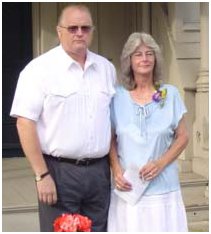
Shari Marchand was diagnosed with pancreatic adenocarcinoma in March 2001, at the age of 52. The tumor was 4 cm and found in the ampulla vater area, extending into the head of the pancreas. She underwent the Whipple procedure the next month. Chemotherapy was Flourouracil (5FU), with sequential radiation. Care was received at Kaiser Permanente, both in Longview, Washington and in Portland, Oregon. Her surgeon was Dr. William O’Connell; her oncologist was Dr. Jason Mann. Shari’s primary caregiver, longtime companion Ron Blasco, also contributed to this story.
Shari and Ron live in Longview, Washington, a small town in the southwest part of the state. For a number of years, Shari managed a series of same-site combination businesses of the type with which most Americans are familiar – gas station/car wash/tobacco shop/espresso shop – supervising 18 employees. Ron is a social worker, a jobs developer at Goodwill Industries, and a teacher of adult basic education and English as a second language at an area college.
In October of 2000, flu-like symptoms and an ear infection sent Shari into a circuitous maze of doctors in the Kaiser health care system. During the months-long chain of examinations, she got progressively sicker, lost weight, and experienced steadily diminishing hearing. Finally in March 2001 – with the addition of puzzling non-related digestive symptoms – Shari got a diagnosis of holes in her eardrums. En route to ear surgery, she reacted with extreme pain as the ENT doctor pressed on her stomach. The medical priorities then shifted ominously.
Back to her primary care Dr. David Young, where blood tests yielded an interim diagnosis of acute pancreatitis, sending Shari briefly online to learn about that. But she didn’t venture beyond that stage. “I just didn’t want to go there.” An ultrasound followed, and then more sophisticated tests at Portland’s Oregon Health and Science University. Finally, the diagnosis she had feared. The doctor gave her the news, and then referred her to the Internet and other outside readings to get details about pancreatic cancer and the possible Whipple procedure, while he made arrangements for her to meet with a surgeon.
So Shari returned home, logged on, and finally went there. “I found out everything I didn’t want to know” regarding the disease, the statistics, and the seemingly barbaric surgery. “I remember turning to Ron and saying ‘I’m going to die, aren’t I?’ He said ‘Oh honey, look at me’”. A few years before, Ron had undergone a quadruple heart bypass. He had been given a 20% chance of survival, Shari had entered his life during the latter part of his fight, and they had together made it through. Now again, when there seemed little to cling to, they joined hands with the belief that she too would beat the odds.
This made Ron an especially effective guide for Shari’s journey. “I wanted us to learn from my own previous pitfalls – I felt I hadn’t asked enough questions, wasn’t proactive enough in my own care. But I also had made it. I tried to bring all of that to our joint fight for Shari.”
Meanwhile, Shari was going through all the common early responses. Anger. Then denial. Then a period of second-guessing. She was a past smoker. She didn’t have the healthiest eating habits. She also wondered about her job, which had exposed her to a variety of petroleum products, sometimes mentioned as possibly contributory to this cancer. Her father had also died of lung cancer. “How many clues did I need? But it was never going to happen to me.”
A week post-diagnosis, Shari met her surgeon, Dr. William O’Connell (now retired). While unfailingly kind throughout their time together, he was not one to mince words. While he explained the intended procedure, Shari gamely mentioned Ron’s quadruple bypass and his beat-the-odds outcome. “What Ron had is a walk in the park” compared to what she would face, he told her. Nice picker-upper, thought Shari. “I had always heard bypass was the worst. And I knew what Ron had suffered. It scared me all over again.”
Dr. O’Connell also issued the standard caveat that the Whipple possibility would depend on what he found when he got inside to look around. “If you wake up, and look and feel like someone from outer space (tubes everywhere), that’s good – it means we were able to do the surgery.” But he was also clear about her outlook. “You have a 2-5% chance of surviving this, but the much more likely scenario is that it will give you about 6 months.”
Shari woke up to the nursing staff washing her hair. Is this heaven? But she then became aware that she could see no “outer space” tubes. Well, I guess the party’s over. Soon Ron came in with great news. They did do the Whipple and she had “passed with flying colors!” They also lucked out with a hospital guesthouse space, sparing him the 120-mile roundtrip drives from their home. “Ron being there 24-7 was a major cause of my good recovery.”
Seventeen days later Shari went home, healing well but struggling mightily with nausea. Her hearing was also greatly compromised, since her much-needed ear surgery had been put on hold when the cancer was discovered. “I was angry about the deafness at first. But if it hadn’t been for that, I probably wouldn’t have been diagnosed early enough to save my life.”
In July her oncologist, Dr. Jason Mann, began Shari’s three months of daily 5FU chemotherapy and radiation. He also painstakingly attempted to get the bottom of her incessant nausea, the toll of which was by now a 90-pound weight loss. Many tests later, it was determined that she had blind loop syndrome, most likely a complication of the Whipple. While corrective surgery is possible, doctors did not recommend that in Shari’s case. Her weight by then stabilized, she was advised to try to live with it. Easier said than done. The nausea continues to this day. Considering the alternative, she has come to accept the reality.
Once the chemo ceased, Dr. Mann shifted to 4-month CT scans/blood work that were extended to 6-month intervals after 2½ years. Spring of 2006 – her 5-year anniversary – will mark the end of the scans altogether. He shares Dr. O’Connell’s preference for the unvarnished truth. “Each time you come, I could tell you it’s back. That’s just the kind of cancer it is.”
So what will Shari feel when the tests stop? Already, when the 4-months intervals became 6, her anxiety crept upwards a little. What if the tumor comes back in month one, and I don’t get tested until five months later? “Actually last time, I just knew he was going to say, it’s back. I usually pride myself on my positive attitude – I’m going to be in the 2-5% group. Now, though, I wait to hear. Maybe once a week, I get severe, sudden-onset stomach pains. And I can’t help but think, … is that the blind loop thing, or the tumor coming back?”
Her need for information has ebbed and flowed. In the days surrounding the diagnosis, she was careful to read only one step or so ahead, not wanting to know too much. “But after surgery, I became an absolute fixture on the computer. It got to where I had to stop – I was making myself crazy. My chances are a little better thanks to surgery. But they’re still chances.”
Ron’s own attitude was helped by his ability to be regularly present, despite his own jobs. In addition to regular caregiving, he was her memory. Shari might say “I’m ok” during a doctor visit. But Ron could say “hey, how about yesterday when you …” There were two of them, not one. And actually three, since his mother Marion Ruddell came to live with them for much of the recovery period, and actively participated in Shari’s care.
Shari’s dietary needs are tricky, given the nausea. She eats very little red meat or raw vegetables. Regular exercise has been one good outcome of her journey. Starting with endless walking “rounds” in the hospital as she worked to get released, she has since made outside walking a standard part of her day.
ChemoAngels – members of this well-known volunteer organization send cards and other tokens of cheer to chemo patients. Once her oncology nurses Kim and Paula connected her to them, Shari began receiving cards from all over the world, and has a huge scrapbook to prove it. Now she’s giving back, sending her own handmade bookmarks to patients. “Instead of just all the bills, it’s great to see a ChemoAngel card in your mailbox. I still just look at them all and smile. You’re not supposed to thank the senders, but I did – completing the loop makes it a network.”
Pancreatica.org was a frequent reference point before and after surgery. Another godsend has been the pancreatic cancer listserv hosted by ACOR (The Association of Cancer Online Resources). “It’s like one big group hug.” She’s even been known to send her bookmarks to new people entering that listserv. [Interested readers may join here: http://www.acor.org/pancreas-onc.html]
Ron says they look back and say to themselves, how did we ever get through that? “But you just do it.” Back at that early moment when Shari finally got on the computer with Ron beside her and confronted the truth about this disease…Ron’s spoken words were totally supportive. But inside, he confesses he was thinking, Oh my God, how can I make her last days comfortable; our time positive? “But, you’ve got one foot on a banana peel and one foot grounded, and you hope the latter one works.” When asked at what point Ron felt they had turned a corner, or that there might be real hope, he said “every day. Every day I woke up and thought, something good’s going to happen today.“
For Shari, telling her story helps. “I didn’t mind talking about it, and the longer I survive, the more I want to talk about it. I feel so lucky. I want everybody who might possibly come in contact with someone with PC to have me as a good example.”
Socialization, always one of Shari’s favorite things, now takes on new meaning. She’s on disability and needs to stick close to bathrooms. But as a recovering (literally) workaholic, she has found other ways to stay busy. She helps Ron with his teaching duties, handling his registrations and paperwork. She volunteers, including at a nearby RV park making contact with vacationers as they check in. She also shares her own story, and hands out the bookmarks at every appropriate chance.
The role of humor? “Huge. That was part of my denial – humor. I had to be humorous, since this is such a siege.”
Shari’s personal relationship with God was crucial. In her opinion, He was there. Here’s just one of many ways she knows that.
As she was getting her pre-surgery epidural, a nurse came in. “May I pray over you?” Shari readily agreed, and her whole family felt great comfort. Later, as they all tried to make contact and thank her, she seemed to have disappeared. But one day, Nancy the OR nurse resurfaced in Shari’s room. “I have to tell you something,” said Nancy. “We go to bed, we know we’re going into surgery the next day, but we don’t have any idea who we’ll be operating on, or for what. We think about it, though. Right before your surgery, I woke in the middle of the night. God seemed to be saying to me, you need to pray for the lady that will be operated on. Nothing like that has ever happened to me before. When I saw you that morning, I knew you were the one.”
And Nancy also shared a new detail. “This is a very tricky procedure. Your doctor has not done the Whipple that much. But still, nothing went wrong in surgery. We didn’t even drop an instrument. Something always goes wrong. But not that day.”
Says Shari of that experience: “Make of it what you will, but I know He was there and has always been. I don’t know why He’s kept me here, but maybe so other people will have hope.”
For the medical team:
For patients:
For caregivers:
For friends and family:
Don’t be afraid of tears. “They want you to buck up, they expect you to buck up. But around your closest friends and loved ones, you should be able to cry, if you need to.”
Shari was asked if there were any well-meaning things not to say. She thought of two. “’Gosh, you don’t look sick.’ How do you answer that? Is that a compliment, or not? Now I say ‘isn’t that wonderful … that I can be so sick and look so good?’” Most of Shari’s acquaintances are aware that the survival rate is usually less than 5 years, a milestone Shari is fast approaching. “’So what happens after then?’” is another stunner of a question. But mostly, her friends have gotten with the program now, especially since some of her symptoms have gone on for so long. “Now they don’t tiptoe around me so much. They think, this is one of her good days, or her bad days. That’s it.”
Don’t give up hope, even if the news sounds hopeless. “I do get depressed, sometimes” says Shari. “I don’t want people to think I don’t. I think why me? But then I stop and ask myself, what’s your anniversary date? Most people don’t even make their first one! So I do go there at times; it’s just that I can then bring it back in perspective.”
Shari has gone from the depths into the light. But from the beginning, she and Ron kept front and center the belief that she would beat the odds, and the appreciation of all that was good in their lives. Her last word to others: “You are not a number. Had I believed those statistics, I wouldn’t be here now. Bottom line? I will survive.“
When it’s dark enough, you can see the stars…
As told to Alison Wiley, an oral historian working with people and organizations to recall and record their important stories.